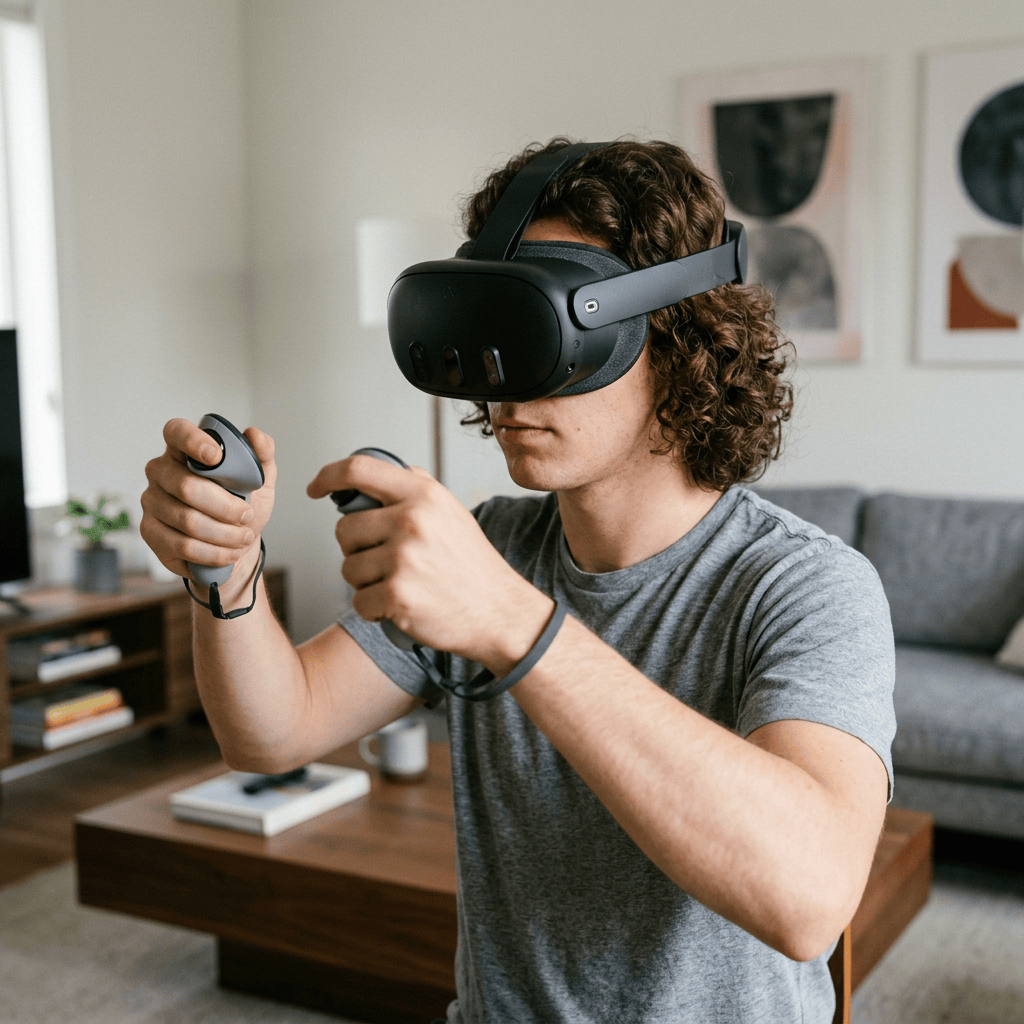
I just sent stakeholders an addendum to my Technical Skills Training Lab proposal, and it comes down to one problem I couldn’t solve with the tools already in the budget: Articulate 360 and Cornerstone OnDemand are great at teaching junior engineers and estimators what they need to know, but neither one can put a person inside an electrical room, and neither one can put a person in front of an energized panel. Those are exactly the two things new hires in construction management need the most practice with before their first year is over.
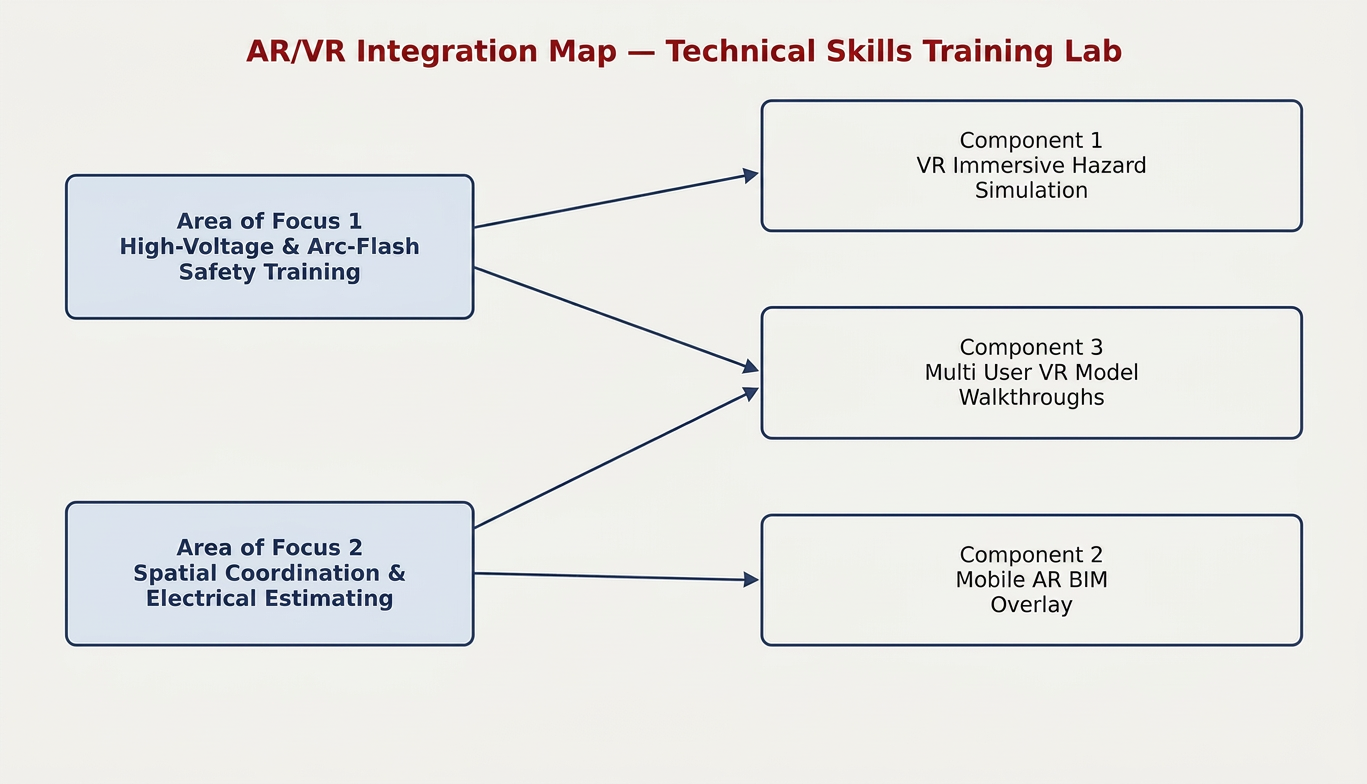
So the addendum recommends three AR/VR components across two areas of the lab’s curriculum. For high-voltage and arc-flash safety training, a standalone VR headset lets a trainee make a wrong PPE call or botch a lockout/tagout sequence and see the consequence play out safely, as many times as it takes. Pribadi et al. (2024) found VR-based electrical safety training beat traditional instruction on both learning outcomes and engagement, which is the whole case for Component 1 in one sentence.
The second area, spatial coordination and electrical estimating, uses mobile AR instead of a headset: a tablet overlays the BIM model’s conduit runs and panel locations onto an empty room, so a junior estimator can catch a clash the way a working estimator does before a bid, not the way a textbook explains one. Chalhoub and Ayer (2018) showed this kind of overlay measurably improves comprehension of electrical design intent over 2D drawings alone.
A third piece multi-user VR walkthroughs of the full model ties both areas together, letting a cohort “stand” in a room that doesn’t exist yet.
None of this replaces the base lab. It’s a $10,300 add-on to a $60,000 investment, piloted with one cohort before we scale it to all six.
References
Chalhoub, J., & Ayer, S. K. (2018). Using mixed reality for electrical construction design communication. Automation in Construction, 86, 1–10. https://doi.org/10.1016/j.autcon.2017.10.028
Pribadi, A. P., Rahman, Y. M. R., & Silalahi, C. D. A. (2024). Analysis of the effectiveness and user experience of employing virtual reality to enhance the efficacy of occupational safety and health learning for electrical workers and graduate students. Heliyon, 10(15), Article e34918. https://doi.org/10.1016/j.heliyon.2024.e34918


Leave a comment